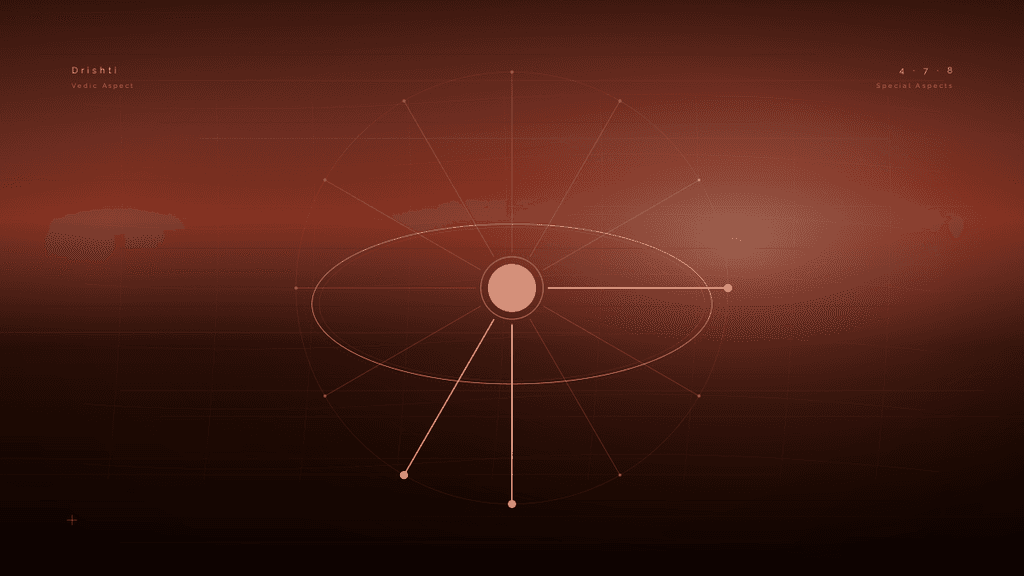
Moon aspect on natal planets: the receptive 7th drishti
The Moon casts a single aspect, the full 7th, and it works by feeling rather than force. It colours the planet it aspects with receptivity, emotional tone and public resonance, and its strength rises and falls with the Moon's own phase. This is the receptive drishti, read planet by planet.
The aspect framework for the Moon
Every planet aspects the 7th sign from where it sits. Mars, Jupiter and Saturn add special aspects; the Moon does not. It casts the 7th aspect alone, a full opposition from its sign onto the seventh sign from it. What makes the Moon aspect distinctive is not its geometry but its variability: the Moon's brightness changes through the month, and a bright waxing Moon casts a far stronger, steadier aspect than a dark waning one from the same position.
What the Moon does to a planet it aspects
The Moon is the karaka of the mind, the emotions, receptivity, the mother, the public and the mass. When it aspects a planet, it links that planet's significations to the emotional life and to popular, felt experience. The aspected planet is coloured with sensitivity and often gains a nurturing or mass-appeal quality: its significations are experienced through feeling and reflected back by the public. The same receptivity can read as moodiness, over-sensitivity or dependence on external validation around the aspected planet's themes. The Moon steadies or unsettles depending on its phase and dignity.
Planet-by-planet Moon aspect signatures
The Moon can aspect all eight of the other grahas, since it travels the full zodiac.
Moon aspect on the Sun
The full-moon axis of the chart, Moon opposite Sun. The emotional nature is set against the will and the ego, which can read as a rich, visible personality that feels deeply and is seen clearly, or as a standing pull between what the heart needs and what the self drives toward. Born near the full moon, the mind is bright and outward; the aspect exposes the feeling-life to the light of the identity.
Moon aspect on Mars
The Moon aspecting Mars links feeling to drive. It can read as emotionally-charged courage, a protective, feeling-led assertiveness and passion, and it can read as a hot temper, emotional impulsiveness and reactivity. Mars gains a felt, sometimes volatile edge under the Moon aspect; the mind and the fighting instinct are coupled.
Moon aspect on Mercury
The Moon aspecting Mercury couples mind and intellect, feeling and thought. It supports an intuitive, emotionally-attuned intelligence, expressive communication and a memory tied to feeling. It can also read as a mind swayed by mood, thinking that runs with the emotions rather than checking them. Speech and reasoning take on the Moon's receptivity.
Moon aspect on Venus
Two soft, relational bodies. The Moon aspecting Venus deepens the emotional and aesthetic life, supporting warmth, romantic feeling, artistic sensitivity and a nurturing approach to relationship. The risk is emotional dependence in love and a tendency to seek comfort through pleasure. Venus's significations are made tender and feeling-led under the Moon aspect.
Moon aspect on Jupiter
The Moon aspecting Jupiter is a benefic, steadying combination, sometimes read alongside the Gajakesari pattern when the geometry and dignity support it. It links feeling to wisdom and generosity, supporting an emotionally-wise, hopeful, popularly-liked expression of Jupiter's significations. The mind is broadened and the heart is lifted. Well placed, it is one of the gentler aspects in the chart.
Moon aspect on Saturn
The Moon aspecting Saturn sets feeling against structure, delay and duty, a combination classical texts read with caution because Saturn's heavy, restrictive nature bears down on the sensitive Moon-significations. It can read as emotional seriousness, endurance and a mature, disciplined feeling-life, and it can read as melancholy, emotional heaviness or a sense of being weighed down. The Moon's condition matters greatly here.
Moon aspect on Rahu
The Moon aspecting Rahu couples the mind with the amplifier, and classical teaching flags this as a sensitive combination, sometimes read near the Grahan or eclipse-axis theme when the nodes and luminaries interact. It can read as a powerful, unconventional, publicly-magnetic imagination, and it can read as restlessness, anxiety and an unsettled mind chasing amplified desires. The feeling-life is intensified and destabilised.
Moon aspect on Ketu
The Moon aspecting Ketu links the mind to the point of detachment and dissolution. It can read as an intuitive, spiritually-inclined, self-contained emotional nature, and it can read as emotional detachment, a sense of not being fully present, or feelings that dissolve rather than settle. The Moon's receptivity meets Ketu's pull toward withdrawal.
What the Moon aspect does not predict
The Moon aspect is an emotional colouring, not an event. It says the aspected planet is felt, receptive and linked to public resonance, with a strength that tracks the Moon's phase. It does not predict specific outcomes and it does not by itself make a chart emotionally strong or fragile. A Moon aspect from a bright, well-placed Moon reads very differently from the same aspect from a dark, afflicted one. Tempora weighs the aspect against the Moon's phase and dignity, the aspected planet, the house context and the running dasha, and names the effect size rather than amplifying it.
When the Moon aspect activates in the life
The aspect is present from birth and becomes a live theme during the Moon mahadasha, the ten-year major period, and during Moon antardashas inside other major periods. It is uniquely sensitive to the monthly cycle, since the transiting Moon returns to its natal sign every month and briefly reinforces the pattern. Outside those windows it sits as an emotional quality of the aspected planet.
How Tempora computes the Moon aspect
Tempora computes the Moon's sidereal position with the True Pushya Paksha ayanamsa via Swiss Ephemeris, identifies the 7th sign from it, and reads the full aspect onto whatever planet sits there. The Moon's phase, from its angular distance to the Sun, and its dignity are applied as filters, in line with the method set out in Tempora's reproducible astrology piece.
Frequently asked questions
Which houses does the Moon aspect?
The Moon casts only the full 7th aspect, counted from the sign it occupies. It has no special drishti, unlike Mars, Jupiter and Saturn. So a Moon aspect is always a straight opposition across the chart onto the planet in the seventh sign from it.
What does a Moon aspect do to a planet?
The Moon is the significator of mind, emotion, receptivity, the mother, the public and the mass. When it aspects a planet it colours that planet's significations with feeling and receptivity, and it links them to the emotional life and to public or popular resonance. A planet under a Moon aspect is felt rather than forced, and it often carries a mass-appeal or nurturing quality. The strength of the effect depends heavily on the Moon's own condition: waxing and full, the aspect is strong and steadying; waning and dark, it is thinner and more changeable.
Can the Moon aspect every planet?
Yes. Unlike the Sun, which can never reach the 7th from Mercury or Venus, the Moon travels the whole zodiac each month and can sit opposite any planet. So the Moon can aspect all of the Sun, Mars, Mercury, Venus, Jupiter, Saturn, Rahu and Ketu. The Moon aspecting the Sun is the full-moon axis of the chart.
Is a Moon aspect good or bad?
Neither by itself. A Moon aspect adds sensitivity, receptivity and emotional connection to the aspected planet, which supports empathy, popular appeal and a felt, intuitive expression of that planet. It can also add moodiness, over-sensitivity and dependence on external validation to the same significations. Whether it steadies or unsettles depends on the Moon's phase and dignity, the aspected planet, and the running dasha.
When does a Moon aspect activate in the life?
The Moon aspect is a standing feature of the chart that activates most strongly during the Moon mahadasha, its ten-year major period, and during Moon antardashas within other major periods. It is also sensitive to transits and to the monthly lunar cycle, since the transiting Moon returns to reinforce the natal pattern every month. Outside those windows it sits as an emotional colouring on the aspected planet.
How is the Moon aspect calculated?
Tempora computes the Moon's sidereal position with the True Pushya Paksha ayanamsa via Swiss Ephemeris, identifies the 7th sign from it, and reads the full aspect onto whatever planet occupies that sign. The Moon's phase, computed from its angular distance from the Sun, and its dignity are applied as filters, because a strong bright Moon and a weak dark Moon cast very different-strength aspects from the same geometry.
Read next
This article documents conventional Vedic teaching on the Moon's drishti onto natal planets and Tempora Research's aspect reading method. Internal audit log maintained for methodology revisions. This article represents conventional Vedic teaching and Tempora Research method documentation. It does not constitute medical, financial, legal or professional advice.
This article was first published on 30 July 2026. It documents conventional Vedic teaching on Jupiter's benefic drishti onto natal planets (5th, 7th and 9th aspects) and Tempora Research's aspect reading method. Internal audit log maintained for methodology revisions; any subsequent material change to the framework above will be appended here with a dated note. This article represents conventional Vedic teaching and Tempora Research method documentation. It does not constitute medical, financial, legal or professional advice.