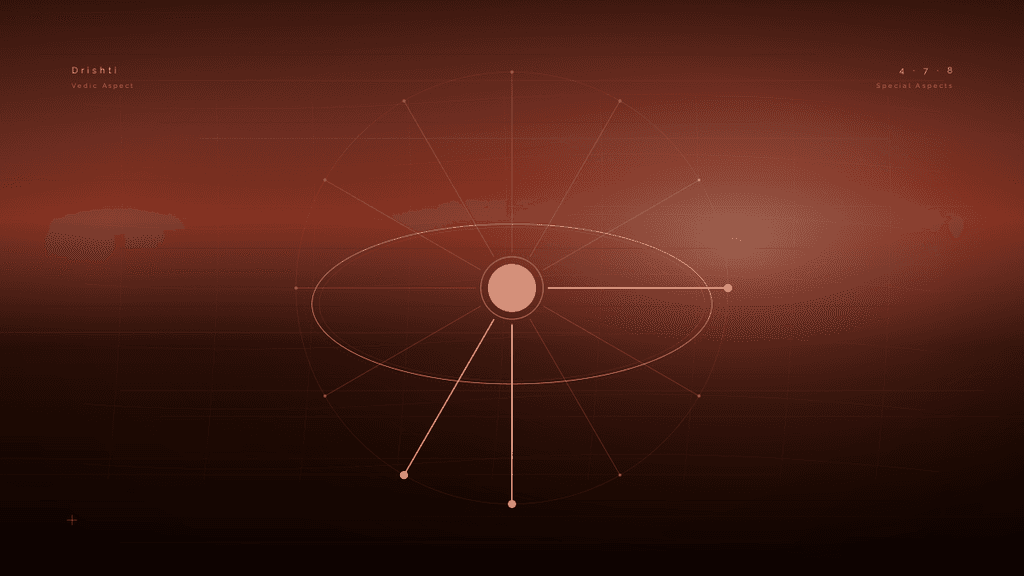
Sun aspect on natal planets: the exposing 7th drishti
The Sun casts a single aspect, the full 7th, and it does not soften. It exposes the planet it aspects, charging it with authority and vitality while risking ego-inflation and a scorching of the planet's gentler side. This is the exposure drishti, read planet by planet, with one hard astronomical limit built in.
The aspect framework for the Sun
Every planet in Vedic astrology aspects the 7th sign from where it sits, a full opposition across the chart. Mars, Jupiter and Saturn add special aspects on top of the 7th: Mars the 4th and 8th, Jupiter the 5th and 9th, Saturn the 3rd and 10th. The Sun adds nothing. It casts the 7th aspect alone. So a Sun aspect is always a clean planet-to-planet opposition, the Sun in one sign throwing its full drishti onto whatever sits in the seventh sign from it.
What the Sun does to a planet it aspects
The Sun is the atmakaraka in significance, the soul-significator, and the karaka of authority, ego, vitality, government, the father and visibility. When it aspects a planet, it pushes that planet into the light. The aspected planet's significations become more visible, more central to the identity and more charged with authority and will. This is strengthening for the planet's public and leadership dimension. It is also a heat. The Sun's aspect can inflate the ego-side of the aspected planet, provoke pride and authority-conflict around its significations, and scorch its softer, more relational qualities, a milder cousin of the combustion that happens when a planet stands right beside the Sun.
Planet-by-planet Sun aspect signatures
The Sun aspects six of the nine grahas. Mercury and Venus are excluded by astronomy, covered in their own section below.
Sun aspect on the Moon
The Sun aspecting the Moon is the full-moon axis of the chart: Sun and Moon in opposition. The mind and emotional nature are put under the light of the will and the ego. This can read as a strong, visible personality with a clear separation between public identity and private feeling, and it can read as a standing tension between what the self wants and what the heart needs, or between father-significations and mother-significations. The Moon is exposed rather than nurtured under this aspect.
Sun aspect on Mars
Two hot, assertive bodies in opposition. The Sun aspecting Mars charges the drive, courage and competitive edge with authority and visibility, a leadership and command signature. The same heat can tip into aggression, ego-driven conflict and a hair-trigger around challenges to status. Mars gains force and exposure under the Sun aspect; it does not gain restraint.
Sun aspect on Jupiter
The Sun aspecting Jupiter lights up the significations of wisdom, teaching, dharma and counsel with authority and public visibility. It supports the teacher-in-a-position-of-standing and the advisor whose judgement is seen. The risk is a swelling of the ego-dimension of belief: conviction hardening into pride, the guru who cannot be told. Jupiter's expansive nature amplified by the Sun's authority is powerful and needs the humility Jupiter is supposed to carry.
Sun aspect on Saturn
The classic father-versus-structure opposition. The Sun is authority, ego and the father; Saturn is discipline, delay, hierarchy and duty. The Sun aspecting Saturn sets the will against the very structures Saturn represents, and it exposes Saturn's slow, heavy significations to the glare of ego and visibility. It can read as friction with authority and institutions, a career of tension between personal will and systemic constraint, or father-related structural themes. Handled well, it is authority earned through sustained work; handled badly, it is ego chafing against every rule.
Sun aspect on Rahu
The Sun aspecting Rahu exposes and energises the amplifier. Rahu's obsessive, boundary-pushing hunger is charged with authority and visibility, which can drive extraordinary worldly ambition placed in the public eye, and can equally inflate the ego into overreach around whatever Rahu touches. The eclipse relationship between the Sun and the nodes gives this aspect a charged, high-visibility, sometimes destabilising quality.
Sun aspect on Ketu
The Sun aspecting Ketu exposes the point of detachment and past-life mastery to the light of the ego and the will. It can read as a visible, authority-charged expression of Ketu's specialised, self-effacing genius, or as a standing tension between the drive for recognition and Ketu's pull toward withdrawal and dissolution. The nodal-eclipse relationship again gives the aspect a charged edge.
Why the Sun cannot aspect Mercury or Venus
This is the one hard limit, and it is computational, not interpretive. Mercury is an inner planet that never appears more than about 28 degrees from the Sun in the sky. Venus never appears more than about 48 degrees away. The 7th aspect requires the aspected planet to sit roughly six signs, about 180 degrees, from the aspecting planet. Mercury and Venus can never get that far from the Sun, so they can never occupy the 7th from it. The Sun's aspect on Mercury and the Sun's aspect on Venus are therefore astronomically impossible configurations. Any chart or reading that claims a Sun aspect on Mercury or Venus by whole-sign drishti has made an error. Mercury and Venus relate to the Sun through conjunction and combustion, never through the 7th aspect.
What the Sun aspect does not predict
The Sun aspect is a dispositional colour, not an event. It says the aspected planet is exposed, authority-charged and vitalised, with a risk of ego-inflation. It does not predict specific outcomes, and it does not by itself make a chart powerful or troubled. A Sun aspect on a dignified, well-placed planet reads very differently from the same aspect on a weak or afflicted one. Tempora reads the aspect as one input, weighed against the dignity of both bodies, the house context and the running dasha, and it names the effect size rather than amplifying it.
When the Sun aspect activates in the life
The aspect is present from birth, but it becomes a live theme during the Sun mahadasha, the six-year major period, and during Sun antardashas inside other major periods. It also activates when transiting bodies cross the aspected planet or the Sun. Outside those windows it sits in the background as a standing quality of the aspected planet rather than a dated event.
How Tempora computes the Sun aspect
Tempora computes the Sun's sidereal position with the True Pushya Paksha ayanamsa via Swiss Ephemeris, identifies the 7th sign from it, and reads the full aspect onto any of the Moon, Mars, Jupiter, Saturn, Rahu or Ketu that occupies that sign. Mercury and Venus are excluded by the astronomical limit above. The dignity of the Sun and of the aspected planet, and the running dasha, are applied as configurable filters, in line with the method set out in Tempora's reproducible astrology piece.
Frequently asked questions
Which houses does the Sun aspect?
The Sun casts only one aspect, the full 7th aspect, counted from the sign it occupies. Unlike Mars, Jupiter and Saturn, the Sun has no special drishti. It aspects the 7th sign from itself and nothing else. So a Sun aspect is always a straight opposition across the chart, planet to planet, sign to seventh sign.
Can the Sun aspect Mercury or Venus?
No. This is a computational fact most aspect guides miss. Mercury never travels more than about 28 degrees from the Sun and Venus never more than about 48 degrees, so neither can ever sit six signs away, in the 7th from the Sun. The Sun's 7th aspect can therefore never fall on Mercury or Venus. The Sun can aspect only the Moon, Mars, Jupiter, Saturn, Rahu and Ketu, the bodies that can reach the opposite side of the chart from it.
What does a Sun aspect do to a planet?
The Sun aspect exposes and energises the planet it aspects. The Sun is the significator of authority, vitality, ego, visibility and the father, so a planet under its full aspect is pushed into the light: its significations become more visible, more authority-charged and more central to the identity. The same heat can scorch. Where a benefic Jupiter aspect cushions, a Sun aspect can inflate the ego-dimension of the aspected planet or burn its softer qualities, in a milder version of what combustion does at conjunction.
Is a Sun aspect good or bad?
Neither by itself. A Sun aspect raises the authority, visibility and vitality of the aspected planet, which supports leadership, recognition and self-expression, and it can also inflate pride, provoke ego-conflict or scorch the planet's gentler significations. Whether it reads as strength or strain depends on the aspected planet, the dignity of both the Sun and that planet, and the running dasha. Tempora reads it as an exposure signature, not a verdict.
How is the Sun aspect different from combustion?
Combustion is a conjunction effect: a planet within a few degrees of the Sun is combust, its significations burnt and suppressed. The Sun aspect is the opposite geometry, the full 7th aspect across the chart, and its effect is milder and different in character. Combustion suppresses; the 7th aspect exposes and energises. A planet the Sun aspects is not burnt out, it is put under the spotlight, which is a different reading from a combust planet standing beside the Sun.
When does a Sun aspect activate in the life?
The Sun aspect is a standing feature of the birth chart, but it activates most strongly during the Sun mahadasha, its six-year major period, and during Sun antardashas within other major periods. It also lights up when transit bodies contact the aspected planet or the Sun itself. Outside those windows the aspect sits in the background as a dispositional colour on the aspected planet rather than a live event.
Read next
This article documents conventional Vedic teaching on the Sun's drishti onto natal planets and Tempora Research's aspect reading method. The astronomical limit on the Sun aspecting Mercury and Venus is a computational fact. Internal audit log maintained for methodology revisions. This article represents conventional Vedic teaching and Tempora Research method documentation. It does not constitute medical, financial, legal or professional advice.
This article was first published on 30 July 2026. It documents conventional Vedic teaching on Jupiter's benefic drishti onto natal planets (5th, 7th and 9th aspects) and Tempora Research's aspect reading method. Internal audit log maintained for methodology revisions; any subsequent material change to the framework above will be appended here with a dated note. This article represents conventional Vedic teaching and Tempora Research method documentation. It does not constitute medical, financial, legal or professional advice.