Sun Mahadasha Moon Antardasha: the public-recognition mood window
The Moon's sub-period is the first handover of the Sun mahadasha, taking over once the Sun's own opening antardasha of 3 months 18 days has announced the register. The friendship here is mutual and unqualified in the Parashari matrix, the only pairing of the two luminaries anywhere in the cycle, day and night ruling in turn. Classical writers read the change as authority acquiring a public: the visible self of the Sun is now reflected in reception, mood, mother and household rather than asserted outright. Where the opening weeks declare an identity, these six months test whether anyone is holding it. The texture assigned to Sun-Moon is mild and tidal, moving in monthly rhythm with the Moon's own circuit.
The Moon's natal condition decides how much of that mildness survives contact. A bright Moon, waxing, exalted in Taurus or at home in Cancer, is classically read as giving the pairing warmth, public goodwill and an easy alliance between authority and feeling. A dark or debilitated Moon in Scorpio, waning thin or besieged by malefics, turns the same six months brittle, reputation touchy and the mother-line a source of concern rather than support. The tradition grades the texture, never the events themselves.
Where the sub-period falls in the Vimshottari sequence
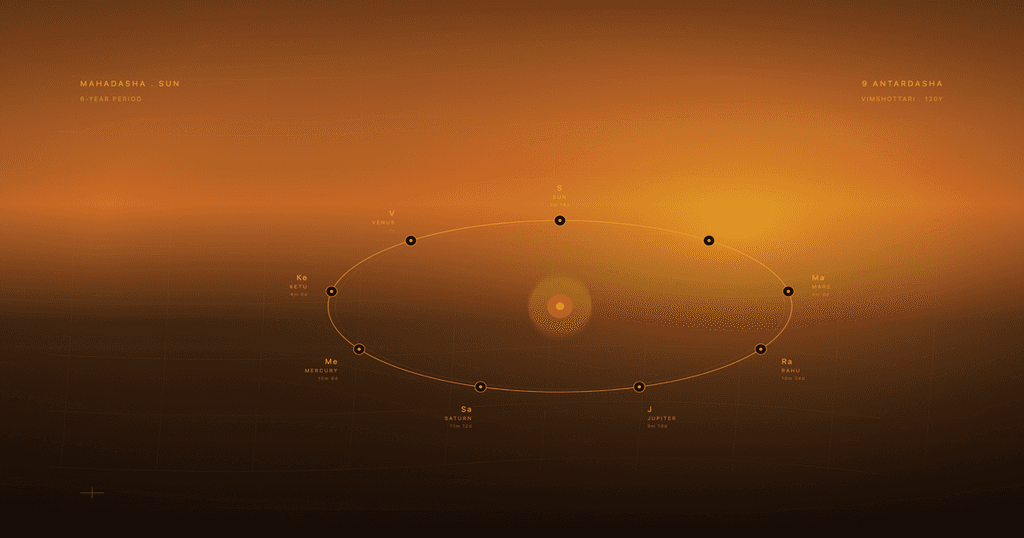
The 6-year Sun mahadasha divides into nine antardasha sub-periods in fixed Vimshottari order starting with Sun itself. The Moon sub-period sits at position 2 of 9. Exact start and end dates for any chart can be computed from the natal Moon nakshatra-pada and the date of Sun mahadasha onset. The Tempora dasha engine produces this to the day.
The arithmetic of this period
Duration first: Sun carries 6 years of the 120-year cycle and the Moon carries 10, so 6 x 10 / 120 gives 0.5 years, exactly 6 months. Only the Sun's own sub-period of 3 months 18 days precedes it, so the Moon antardasha runs from 3 months 18 days to 9 months 18 days of the mahadasha, sitting entirely inside the first year. The container these months open is described in the Sun mahadasha overview.
Sequence position shapes the reading twice over. This is the one cool stretch between two hot ones, wedged between the Sun's own fiery opening and the martial 4 months 6 days of Sun-Mars that follows, so the tradition leans on it as the mahadasha's first chance to consolidate rather than assert. And an antardasha this early lands on fresh ground: whatever the Sun years will become has barely declared itself, so the Moon period colours first impressions, where the same pairing late in a long mahadasha would be reflecting on work already done.
The classical assignments for this sub-period
The BPHS antardasha chapters, Sun mahadasha section, condition this period on the Moon's state: in a kendra or trikona she is assigned marriage, wealth and property, house, land, cattle and conveyances, and exalted or in own sign the list grows to children, royal favours and ambitions fulfilled. A waning or malefic-joined Moon reverses the account toward distress to wife and children, failed ventures, disputes and royal antagonism, and in the 6th, 8th or 12th the text adds danger from water, imprisonment, hard journeys and urinary trouble. Benefics in the 1st, the 9th or a kendra from the dasha lord restore luxuries and a dawn of fortune, so the reckoning from the dasha lord stands beside the reckoning from the lagna throughout. Where the Moon holds maraka lordship the chapter appends a health caution and prescribes the charity of a white cow and a female buffalo. Phaladeepika's bhukti chapter is concordant here, listing destruction of enemies, wealth, agriculture and house-building. These positions enter the engine as classical priors that the individual chart then conditions.
Friendship status and pairing reading
In the classical Parashari friendship matrix, Sun views Moon as friend. The friend-pair classification means the 6 months sub-period classically delivers outcomes where Sun's register (authority, identity, the father-line, dignified-recognition and the visible self) and Moon's register (mind, mother, emotional foundation, public reception and the cyclic register) integrate constructively. Events typically surface from both karaka domains in alignment rather than friction.
The Moon karaka overlay
Moon is the karaka of mind, mother, emotional foundation, public reception and the cyclic register. Across the 6 months sub-period, this karaka set overlays on top of Sun's 6-year authority, identity, the father-line, dignified-recognition and the visible self register. The combined reading is the central output of the sub-period.
How Moon's natal dignity shapes the reading
Moon's natal sign and house set the floor for the 6 months sub-period. Moon at exaltation gives the strongest reading. Own-sign and mooltrikona placement gives clean expression. Debilitation introduces friction that the sub-period must work through. Combust and retrograde state, conjunctions with malefics or benefics and the dispositor's strength all further modulate the reading. See the Moon mahadasha overview for the per-dignity breakdown.
Event classes typical to Sun-Moon sub-period
The 6 months Sun mahadasha Moon antardasha typically surfaces events across these specific domains:
- Constructive integration of Sun-register with Moon-register: friend-pair sub-periods classically deliver outcomes where both planets' karakas align rather than friction.
- Events in Moon's natural karaka domain: mind, mother, emotional foundation, public reception and the cyclic register.
- Events specific to the natal house Moon occupies in the chart.
- Events where the Sun-mahalord and Moon-antarlord houses (both natal and ruled) interact (aspect, mutual reception or natal conjunction).
Transit confirmation protocol
The sub-period reading sets a structural pressure floor of 6 months. Specific event timing inside that window requires the pratyantara (sub-sub-period) overlay and a transit cross-check.
Two transit overlays do most of the work. The standard targets to track: transit Sun aspecting natal Moon, transit Moon through the natal 4th house, transit Saturn aspecting natal Moon, transit Sun through Cancer or its trines. These transits intensify the Sun-Moon dynamic within the broader sub-period and concentrate event timing on those windows.
The pratyantara (sub-sub-period) inside the antardasha gives finer timing. The Sun-Moon-Sun pratyantara (about 2 months 5 days) and the Sun-Moon-Moon pratyantara (about 1 month 10 days) carry the most concentrated mother and emotional-clarity signal within the 16-month sub-period. The Sun-Moon-Saturn pratyantara (about 2 months 17 days) reads as the longevity-and-ageing window for mother-line concerns. Cross-checking the pratyantara against the transit overlay gives event timing to the week. Tempora's dasha engine produces this data to the day for any chart.
What the framework does not predict
The Sun-Moon reading is structural. It flags a 6-month window where the conditional probability of three named event classes lifts above chance, but it does not predict that any specific native will experience a specific event inside that window, nor the direction of any event that does fire.
A mother event or home consolidation during the sub-period can read as the loving recognition of a long-built foundation or as a difficult transition that opens a different stage of life; the chart's broader natal Moon strength determines emotional integration capacity. The framework times the pressure, not the result and timing finer than the antardasha band needs the pratyantara sequence and the transit overlay for the date in question.
How this connects to the broader Sun Mahadasha
The Sun-Moon sub-period is the second antardasha inside the 6-year Sun Mahadasha. Reading the sub-period in isolation captures the 6 months; reading it inside the Mahadasha gives the broader arc that places the authority meets emotional resonance reading in its proper structural context.
The Tempora Sun Mahadasha method article covers the dispositor analysis, natal-house framework and the broader 6-year texture that this sub-period sits inside. The conditional probability framework holds across the full series: each antardasha is a flagged window for specific event classes whose probability is elevated relative to chance.
This period against the 2026 to 2028 sky
Both lords of this combination are luminaries, which makes the solar eclipse of 12 August 2026 on the Cancer-Leo cusp the calendar event that belongs to this page. An eclipse is the Moon standing before the Sun, the two lords of this very period meeting in the sky, and classical practice treats eclipse windows inside luminary dashas as time for restraint in launches and public claims. The caution needs its counterweight: the eclipse lasts an afternoon, the antardasha lasts six months and most natives running Sun-Moon through August 2026 will cross the date without a datable event. The nodal shift of 27 December 2026 then carries Ketu into Cancer, the Moon's own sign, a background colouring for any Sun-Moon period running into 2027 rather than a trigger. Whether either signal touches a given chart depends on where Cancer and Leo fall by house from the natal ascendant, the ground the Moon mahadasha overview works through for this page's antardasha lord.
Frequently asked questions
How long is the Sun Mahadasha Moon Antardasha and where does it fall in the Vimshottari sequence?
The Sun Mahadasha Moon Antardasha runs 6 months. It is the second antardasha inside the 6-year Sun Mahadasha, opening after the Sun-Sun antardasha (3 months 18 days). The full sequence inside the Sun Mahadasha runs Sun-Sun, Sun-Moon, Sun-Mars, Sun-Rahu, Sun-Jupiter, Sun-Saturn, Sun-Mercury, Sun-Ketu and Sun-Venus. Exact start and end dates can be computed from the natal Moon nakshatra-pada and the date of Sun Mahadasha onset.
What does Moon signify in this sub-period and why does it read as authority meets emotional resonance?
Moon is the karaka of mind, emotions, mother, home, comfort, womanly figures, intuition, mental fluctuation, lunar cycles. During the broader Sun Mahadasha's authority and identity reading, Moon contributes the emotional-public overlay. The sub-period sits at the second position in the antardasha sequence and reads as the Sun authority and identity register meeting Moon's mind, emotion, mother and mass-public significations.
How does Moon's natal dignity shape the Sun-Moon sub-period reading?
Moon's natal house, sign and aspectual state set the floor for the 6-month sub-period. Moon exalted in Taurus, in own sign Cancer or in angular houses (1st, 4th, 7th, 10th) softens the reading toward more auspicious outcomes. Moon debilitated in Scorpio introduces friction. Aspects from Saturn bring sustained structural pressure; aspects from Mars bring competitive or confrontational pressure.
What kinds of events historically correlate with the Sun-Moon sub-period?
Three event classes correlate. Mother events: Mother health transitions, mother relationship shifts (deepening or distance), inheritance matters from mother's line, womanly-elder mentor relationships activating. The Sun signification over the eld. Home and lifestyle events: Home purchases or renovations, relocations to long-term residence, lifestyle consolidation decisions, family expansion through marriage or birth events. The Moon-home register combined with Sun expans. Emotional and intuitive milestones: Therapeutic openings, emotional integration of long-running material, intuitive insight events, mental clarity phases. Native therapists, teachers and emotionally-attuned professionals describe t. The framework reads these as a structural-pressure window for the event class, not a deterministic predictor.
How does this sub-period connect to the broader Sun Mahadasha?
The Sun-Moon sub-period is the second antardasha inside the 6-year Sun Mahadasha. It opens after the Sun-Sun antardasha (3 months 18 days). The sub-period reading is best held in tandem with the broader Sun Mahadasha reading from the Tempora Sun Mahadasha method article, which covers the natal house and dispositor framework that sets the texture of the full 16 years.
What does the Tempora framework not predict about this sub-period?
The framework identifies a structural-pressure window of approximately 6 months. It does not predict whether a specific native will experience a specific event in that window. It does not predict outcome direction. It does not predict timing finer than the sub-period band without overlaying the pratyantara (sub-sub-period) and the transit overlay for the date in question. The readings carry conventional weight from classical literature; the framework treats them as structural-pressure flags to cross-check against transit data.
How early in the Sun mahadasha does the Moon antardasha arrive?
Only the Sun's own sub-period of 3 months 18 days comes before it, so the Moon antardasha opens under four months into the 6-year mahadasha and closes at 9 months 18 days, entirely within the first year. Its duration follows from the constants: 6 years times 10 years divided by 120 equals exactly 6 months.
What does the 12 August 2026 solar eclipse mean for a native running Sun-Moon?
The eclipse falls on the Cancer-Leo cusp and involves both lords of this antardasha, since a solar eclipse is the Moon interposing before the Sun. Classical practice counsels restraint around eclipse windows during luminary periods. It remains a background signal: the event lasts hours, the antardasha lasts 6 months and its relevance to a given chart depends on which houses Cancer and Leo occupy from the natal ascendant.
What do the classical texts say about Sun-Moon?
For Sun-Moon the BPHS Sun mahadasha section ties everything to the Moon's condition: strong in a kendra or trikona she brings marriage, property, cattle and conveyances, waning or afflicted she brings family distress and failed ventures, and the placement from the dasha lord is weighed alongside the placement from the lagna. Maraka lordship carries a health caution with a prescribed charity. Phaladeepika's fixed list for the bhukti, enemies destroyed, wealth, agriculture and building, agrees with the favourable branch. The engine reads both texts as chart-conditioned inputs.
Read next
- Mahadasha: the nine-period Vimshottari framework · the broader cluster this sub-period sits inside
- Sun Mahadasha Mars Antardasha · the next sub-period in the Vimshottari sequence
- Venus Mahadasha Moon Antardasha · the complementary sub-period in the prior Mahadasha
- Jupiter Mahadasha Moon Antardasha · the same antardasha planet in a different Mahadasha
- Mahadasha and Vimshottari planetary periods · the full nine-period framework
- Calibrated lift: the discipline that turns Vedic astrology into research
This article represents conventional Vedic teaching and Tempora Research method documentation. It does not constitute financial, legal or professional advice. Internal audit log maintained.